Description: Great pasta, can be served as a main or side dish. Serving cold is great when it’s hot. You can keep it in the fridge and serve it as a salad.
Serves: 2
Cooking time: 20 minutes
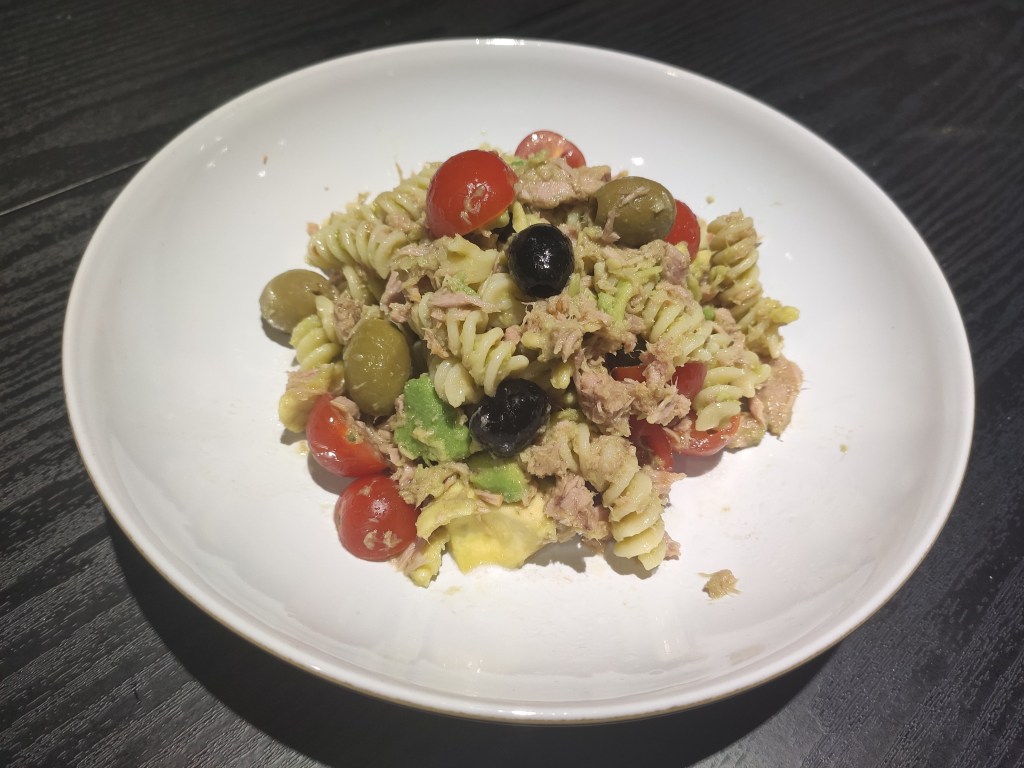
Ingredients
- Fusilli pasta – 140g
- Avocado medium – cut in small pieces 120g or 1 piece
- Tuna – break into small chunks, 1 tin (use no drain if not, remove oil before cooking) or 110g
- Cherry tomatoes – 8 pieces or 50g
- Black olives – 10 pieces or 15g
- Olive oil – 1 tablespoon
- Salt – 1 dash
- Ground black pepper – according to preference
Method
1. Cook the pasta until al dente in plenty of boiling water with salt.
2. Meanwhile, add ½ tablespoon of olive oil and crush the avocado in the bowl to make the paste.
3. Add tuna and mix with avocado paste.
4. When pasta is boiled, add the rest of the avocado, tomatoes, pasta, salt, black pepper and ½ tablespoon of olive oil in the same bowl and mix well.
To serve: Sprinkle additional ground black pepper.
Nutritional Values Per Serving
| Kcal | Protein | Fat | Carbs | Fibre | Sugars | Salt | Saturated Fat | Vitamin B2 | Vitamin B12 | Vitamin E |
|---|---|---|---|---|---|---|---|---|---|---|
| 520.2 | 24.8g | 22.3g | 57.8g | 6.8g | 3.6g | 0.9g | 2.1g | 0.4mg | 1.2μg | 2.6mg |
| 26.0% | 49.5% | 31.8% | 22.2% | 22.8% | 3.9% | 15.3% | 10.7% | 40.4% | 80.7% | 88.1% |
Nutritional Tips
Avocados are actually fruits. They are rich in fibre and mono-unsaturated fatty acid (MUFA). The main types of fat in food are: saturated fats and unsaturated fats. Avocado and olive oil contain MUFA. So MUFA has 1 double bond.
MUFA helps protect your heart. It helps maintain HDL cholesterol (good cholesterol) and reduce LDL cholesterol (bad cholesterol) in your blood. This means it reduces the risk of cardiovascular disease including heart attack and stroke. Therefore, it is important to note that not all fats are bad and some are beneficial to our health.
MUFA-rich foods are olive oil, rapeseed oil and spreads made from these oils, avocados, nuts (almonds, brazils, and peanuts).
Saturated FAs (SFA): no double bonds
Monounsaturated FAs (MUFA):1 double bond (2 missing hydrogen atom)
Polyunsaturated FAs (PUFA): 2 or more double bonds (4 or more missing hydrogen atom)
 Mignonne Nutri-Cuisine