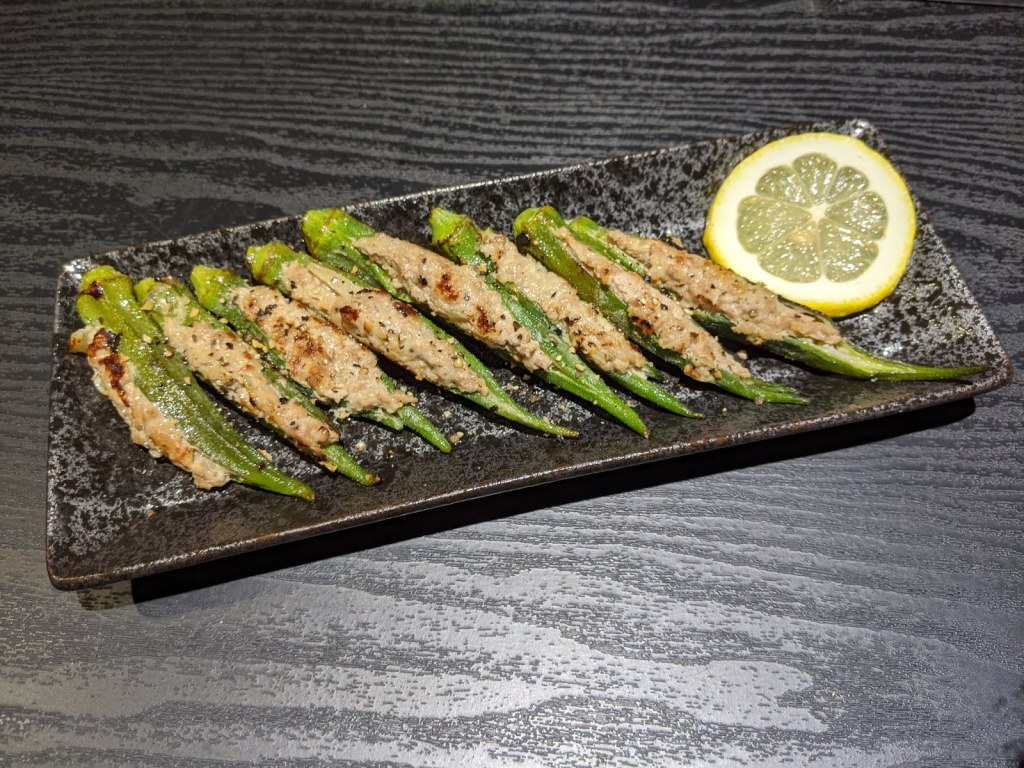
Description: Okra filled with minced meat. One of the izakaya-style dishes. For those who are not big fans of vegetables, this may be a way to eat them.
Serves: 3
Cooking time: 25 minutes
Ingredients
- Okra – 240g or 24 pieces
- Garlic – chopped, 2 cloves
- Onion – chopped into fine pieces, 100g or 1 small piece
- Pork mince meat (10%) – 200g
- Ground black pepper – 1 dash
- Soy sauce – ⅔ tablespoon
- Sesame oil (optional) – 1 teaspoon
Method
1. Wash the okra and pat them dry. Trim off the edge if preferred.
2. Make an incision into okra for filling.
3. In a large bowl, mince the meat, garlic, onion, soy sauce, sesame oil and black pepper. Mix well until it becomes smooth.
4. Place the filling inside the okra (if hard, remove the seeds and mix them with meat and place the filling).
5. Braise them in a non-stick frying pan with a lid for about 5 minutes (turn over in 2-3 minutes) in total until cooked.
To serve: Squeeze the lemon or sprinkle additional ground black pepper if you prefer.
Nutritional Values Per Serving
| Kcal | Protein | Fat | Carbs | Fibre | Sugars | Salt | Saturated Fat | Vitamin C | Vitamin B1 | Vitamin B6 |
|---|---|---|---|---|---|---|---|---|---|---|
| 157.7 | 18.4g | 6.9g | 10.1g | 3.2g | 2.6g | 0.6g | 2.1g | 21.5mg | 0.4mg | 0.6mg |
| 7.9% | 36.7% | 9.8% | 3.9% | 10.7% | 2.9% | 10.3% | 10.7% | 53.7% | 53.7% | 54.0% |
Nutritional Tips
Pork is a good source of protein, vitamins and minerals. Pork can be a part of a balanced diet. However, some part of the meat is made of a large amount of fat. For example, when you go to the supermarket, there are different fat contents for minced meat such as 4% (31g of protein per 100g, 121 kcal, raw, according to USDA) vs 16% (17g of protein per 100g, 218kcal, raw, according to USDA). 4% one would be lower in fat, but higher in protein content instead. Low-fat options are usually beneficial as there is less saturated fat content. However, it is important to think about the protein content of those following certain diets (e.g., diabetes or renal diet). As always, please seek professional advice if in doubt.
 Mignonne Nutri-Cuisine