Description: If you are eating salmon once a week to achieve 1 portion of oily fish (recommended 2 portions of fish and 1 of them should be oily fish) and running out of the recipe, this may be your next salmon recipe to try.
Serves: 2
Cooking time: 15 minutes
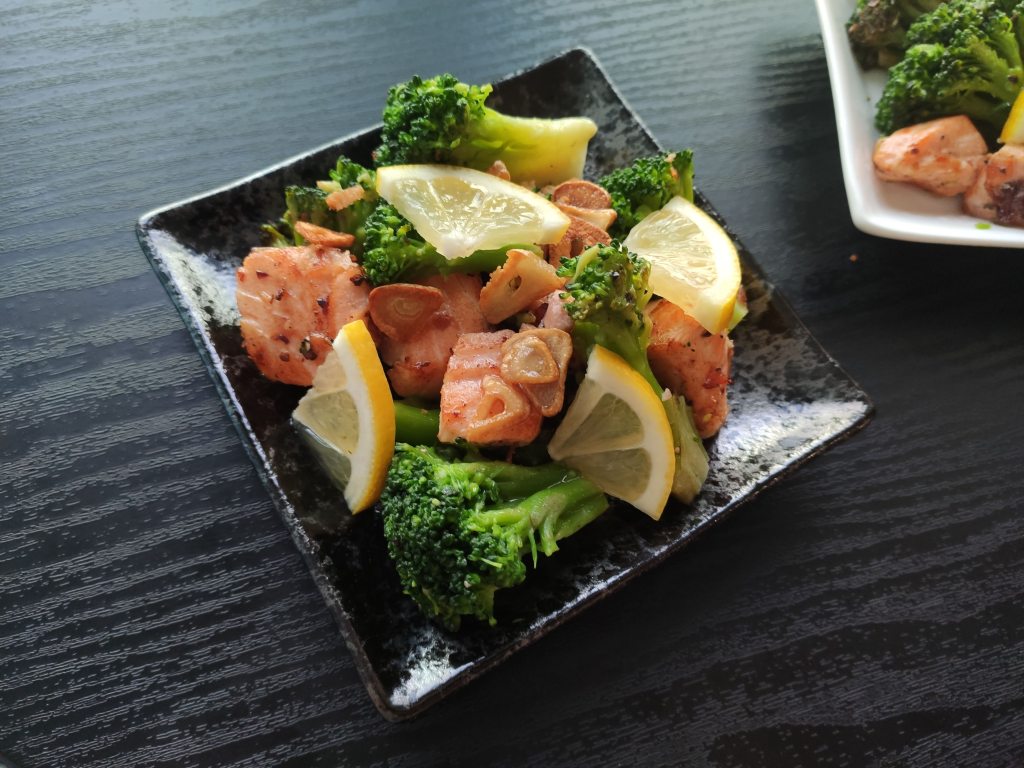
Ingredients
- Broccoli – cut into bite-size, 160g
- Olive oil – 1 tablespoon
- Garlic – chopped, 2 cloves
- Salmon – 300g
- Salt – ½ dash
- Ground black pepper – ½ dash
- Lemon – 1 slice
Method
1. Steam the broccoli.
2. Meanwhile, in a non-stick frying pan, fry the garlic with olive oil over low heat.
3. Add the salmon to the pan, sprinkle some salt and black pepper and cook the salmon well.
4. Once cooked, add the broccoli to the pan and mix well.
Serve: Squeeze the lemon.
Nutritional Values Per Serving
| Kcal | Protein | Fat | Carbs | Fibre | Sugars | Salt | Saturated Fat | Phosphorus | Vitamin B1 | vitamin B6 |
|---|---|---|---|---|---|---|---|---|---|---|
| 404.7 | 33.1g | 27.5g | 6.6g | 2.2g | 1.5g | 0.4g | 4.8g | 418.0mg | 0.4mg | 1.1mg |
| 20.2% | 66.2% | 39.2% | 2.6% | 7.5% | 1.6% | 6.4% | 24.1% | 76.0% | 46.8% | 94.5% |
Nutritional Tips
Cholesterol levels in our blood hugely affect our health (heart disease, stroke, diabetes, renal disease etc), so it’s important to keep an eye on it. One of the important things to do on your own is watch out for what you eat. Salmon is rich in fat but it is a good fat (unsaturated fat) which improves blood cholesterol levels.
Cholesterol travels through our bodies as lipoproteins (protein-covered fats). There are different types of lipoproteins:
Very low-density lipoproteins (VLDL)
Low-density lipoproteins (LDL)
Intermediate-density lipoproteins (IDL)
High-density lipoproteins (HDL)
It is vital to maintain healthy levels of both good and bad types of cholesterol for our health.
 Mignonne Nutri-Cuisine