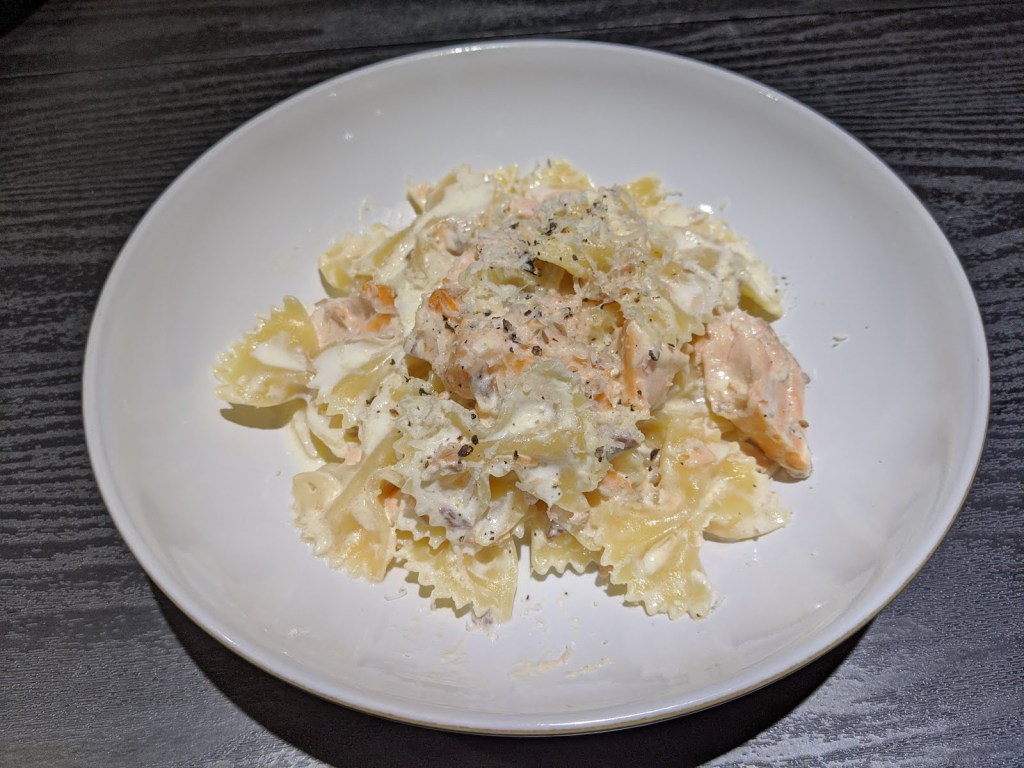
Description: The combination of salmon and cream goes really well. The dish looks cute with butterfly-shaped pasta and salmon. We also enjoy our meals with our eyes 🙂
Serves: 2
Cooking time: 20 minutes
Ingredients
- Farfalle – 180g
- Unsalted butter – 10g
- Garlic – crushed, 2 cloves
- Salmon – chopped in small chunks, 150g
- Salt – 2 dashes
- Parmesan cheese – grated, 10g
- Single cream – 150 mL
- Ground black pepper – according to the personal taste
Method
1. Cook the pasta until al dente in plenty of boiling water with salt.
2. When pasta is almost cooked, in a large non-stick frying pan, cook the garlic and the salmon with salt (1 dash) over low heat.
3. When the salmon is almost cooked, add the drained pasta to the frying pan, then toss.
4. Add the cream to medium heat and stop before it boils. Mix well.
5. Sprinkle parmesan cheese and ground black pepper.
| Kcal | Protein | Fat | Carbs | Fibre | Sugars | Salt | Saturated Fat | Vitamin B2 | Vitamin B3 | Vitamin E |
|---|---|---|---|---|---|---|---|---|---|---|
| 674.3 | 31.0g | 30.4g | 68.6g | 3.7g | 3.2g | 0.7g | 14.3g | 0.5mg | 13.0mg | 2.7mg |
| 33.7% | 62.0% | 43.4% | 26.4% | 12.3% | 3.6% | 11.6% | 71.4% | 49.6% | 99.7% | 89.2% |
Nutritional Values Per Serving
Nutritional Tips
Salmon contains poly-unsaturated fatty acid (omega-3) which are effective in lowering the risk of coronary heart disease and cholesterol.
Fatty acids have different structures depending on the number of carbon and hydrogen atoms. When hydrogen atoms are missing, C atoms form double bonds.
Omega−3 fatty acids are types of fat and they are also called ω−3 fatty acids or n−3 fatty acids. They are polyunsaturated fatty acids (PUFAs) and characterized by the double bond. These bonds are located 3 carbon atoms away from the terminal methyl group (CH3) in their chemical structure. The other side of the structure has a carboxyl group. If bonds are 6 carbon atoms away, it is called omega-6 fatty acids or ω−6 fatty acids or n−6 fatty acids.
PUFAs have 2 or more double bonds while saturated fatty acid (bad fat) does not have any double bond.
Now you can take away the key point .. no double bond => not the best for our health 🙂
 Mignonne Nutri-Cuisine