Description: No deep fry but still crispy and tasty. It goes well with white wine, sparkling wine or beer.
Serves: 3
Cooking time: 30 minutes
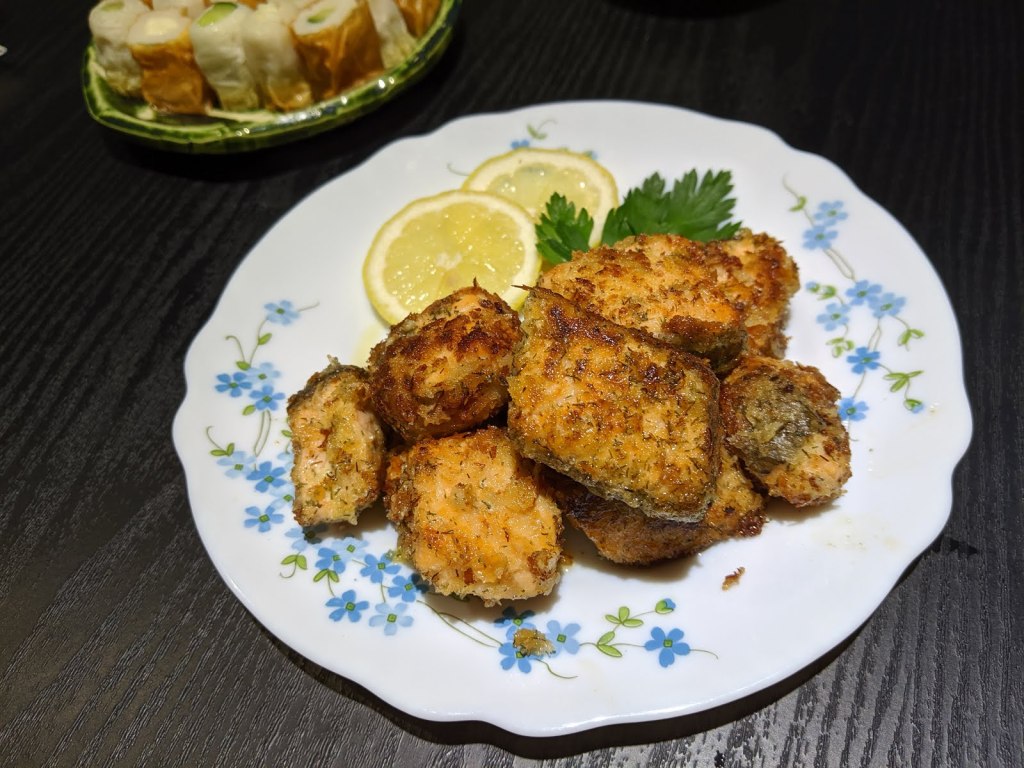
Ingredients
- Salmon – cut into bite size 2 pieces or 280g
- Mayonnaise – 1 tablespoon
- Bread crumb – 30g
- Dill (Dry) – 1 tablespoon
- Sunflower oil – 1 tablespoon
Method
1. Put mayonnaise around the salmon, then cover with bread crumbs.
2. In a non-stick frying pan, add sunflower oil and fry the salmon with medium heat. Once it gets brown, turn it over to fry the other side. Ideally, fry all sides so that it gets crispy.
To serve: Squeeze lemon or mayonnaise according to your preference.
Nutritional Values Per Serving
| Kcal | Protein | Fat | Carbs | Fibre | Sugars | Salt | Saturated Fat | Vitamin A (RAE) | Vitamin E |
|---|---|---|---|---|---|---|---|---|---|
| 235.1 | 6.5g | 16.2g | 17.1g | 4.3g | 3.7g | 1.7g | 5.3g | 263.2μg | 0.9mg |
| 11.8% | 12.9% | 23.1% | 6.6% | 14.4% | 4.1% | 29.1% | 26.4% | 43.9% | 30.6% |
Nutritional Tips
A healthy diet should include at least 2 portions of fish a week (at least one of them should be oily fish such as salmon, sardines, trout and herring). One portion is about 140g. It is advised not to have more than 4 portions of oily fish a week (for pregnant / breastfeeding women, no more than 2 portions). There is no limit for white fish except for certain fishes (such as sea bream, and sea bass). These are due to the pollutants accumulating in our bodies (mercury). Tuna has a larger amount of mercury than any other fish, so pregnant women should eat less than 4 tins or 2 tuna steaks a week. Depending on the individual environment/condition, the recommended intake may vary and be more specific. Tuna does not count as oily fish, you may still eat 2 portions of oily fish in addition to it. Swordfish, shark or marlin also contain a larger amount of mercury, therefore it is advised that children, pregnant women and women who are trying to conceive avoid these, For others, no more than 1 portion a week. (Source: NHS https://www.nhs.uk/live-well/eat-well/fish-and-shellfish-nutrition/ )
If you try to eat 140g of this dish, you will also eat more fat at the same time due to the ingredients and cooking methods used. Therefore, it is important to consider what you will be eating as a whole package. The more you eat, not only there will be more nutrients, but also there will be more fat (in terms of the negative side of fat e.g. saturated fat). Salmon is nutrient-dense and rich in protein, vitamins (especially, B3, B6, B12, D) and minerals (especially, phosphorus, and potassium). If it is simply grilled, roasted or added to a soup, it may help to not increase the extra fat intake.
Vitamin B6 is also known as pyridoxine and it is one of the important vitamin Bs. Vitamin B6 assists our body to metabolise protein and carbohydrates. It ultimately helps to form haemoglobin as it helps in the formation of γ-aminolaevulinic acid which is the first step in porphyrin synthesis. It can be found in meats, whole grain products, fish, and vegetables. Refined cereal products such as white bread or rice are not great sources due to the milling process.
 Mignonne Nutri-Cuisine