Description: Amazing Japanese pork soup “Butajiru”. It warms you up in winter or when you are ill. This soup has a lot of ingredients, so it is a well-balanced meal.
Serves: 8
Cooking time: 30 minutes
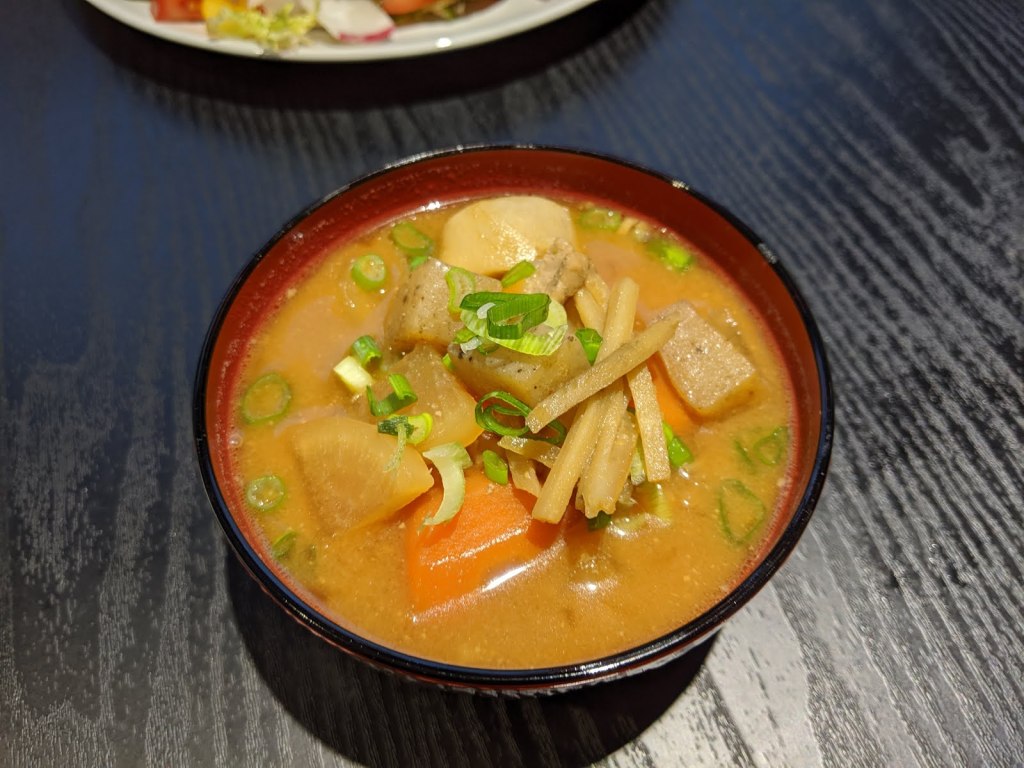
Ingredients
- Pork Belly – chopped in small pieces, 200g
- Carrot – chopped into one bite-size, 1 piece
- Konnyaku – 1 piece
- Burdock root – chopped into small pieces, 100g
- Taro – chopped into one bite-size, 160g or 8 pieces
- Daikon radish – 150g
- Spring onion – chopped, 5 stalks or 100g
- Miso – 8 tablespoons
- Sesame oil – 1 tablespoon
- 1200mL of bonito or kombu kelp dashi stock (You may cook it from scratch – boil the water, switch the heat off, then add 40g of bonito flake wait for 3 minutes, then sieve them with kitchen paper or fine cloth. Alternatively, use extract dashi powder 8g + 1200 mL of hot water)
Methods
1. In a large non-stick pan, fry the pork with sesame oil over medium heat.
2. When the pork is almost cooked, add carrots, burdock, daikon radish, taro, konnyaku and mix well.
3. Add dashi stock to the pan, and boil until all the vegetables are cooked.
4. Add miso to the soup and mix well until miso gets completely dissolved.
5. Switch off the heat and add spring onions.
To serve: sprinkle chilli powder according to personal preference.
Nutritional Values Per Serving
| Kcal | Protein | Fat | Carbs | Fibre | Sugars | Salt | Saturated Fat | Vitamin A (RAE) | Vitamin E |
|---|---|---|---|---|---|---|---|---|---|
| 235.1 | 6.5g | 16.2g | 17.1g | 4.3g | 3.7g | 1.7g | 5.3g | 263.2μg | 0.9mg |
| 11.8% | 12.9% | 23.1% | 6.6% | 14.4% | 4.1% | 29.1% | 26.4% | 43.9% | 30.6% |
Nutritional Tips
Taro is one of the root vegetables and staple food in certain countries (South Asia, Africa etc). It is sold either fresh, frozen, bagged in its own liquid, or canned. Compared to other vegetables, it is a little higher in calories (112 kcal/100g according to USDA) and contains more carbs than other types of vegetables. When it comes to choosing which carbs you are eating day to day, quality matters. Taro is a good source of fibre and contains some vitamins and minerals in larger quantities than normal potatoes (e.g. more fibres, Vitamin E, Calcium, Magnesium, Phosphorus etc, although Vitamin C and iron are richer in normal potatoes). Therefore, taro roots could be a healthy carb choice.
Taro can be added to soups, simmered with other vegetables, fried or even used for cakes. Recently, it has become more and more common to have it in bubble tea (boba tea). As it is starchy, it is important to control yourself for intake regardless of whatever dish you are eating.
This soup contains some carbs, protein and a variety of vitamins and minerals. Due to some ingredients, it contains a good amount of fat (pork belly) and salt (miso). Therefore, it is important to watch out how much you are eating. You may eat some additional carbs which can be rice or noodles and proteins in other meals. Having a vegetable-rich soup as a part of your diet may help to achieve your balanced diet. So these can be one of the best dishes to cook when it is cold or when you are ill. In addition, it is fairly easy to cook and it can be kept in the fridge for several days.
 Mignonne Nutri-Cuisine