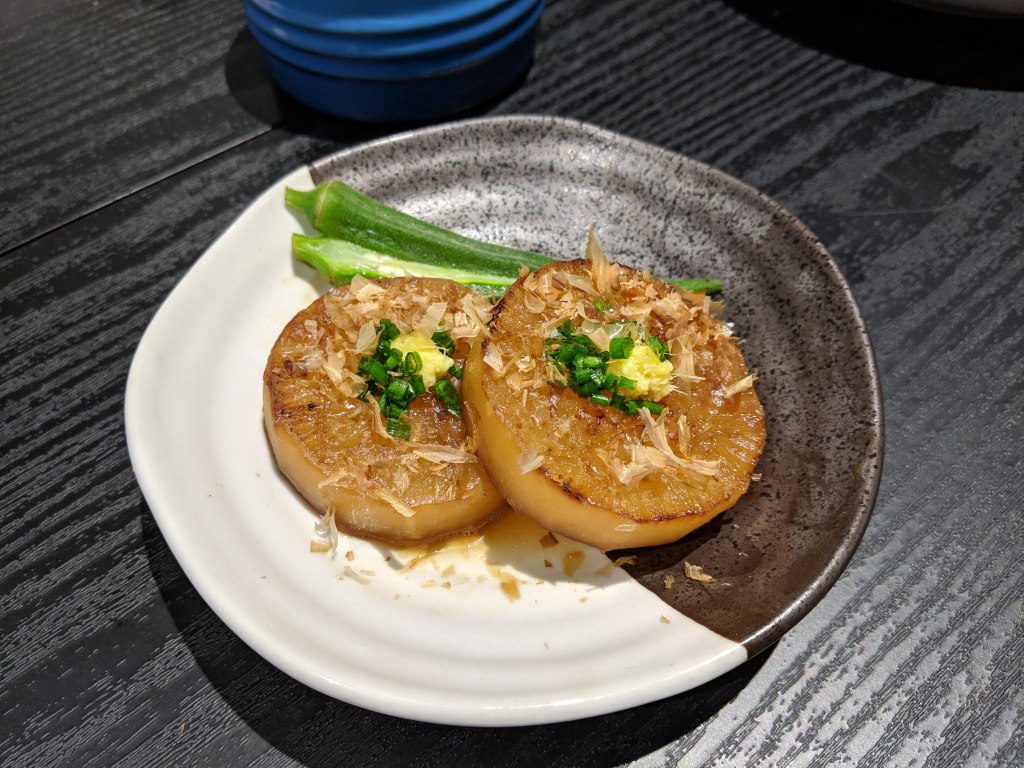
Description: One of Japanese signature dishes. A popular Japanese grilled seasoning “butter ponzu: バターポン酢 / バタポン” was used for this dish. Butter ponzu is an amazing seasoning and it is a mixture of sourness from ponzu and mild flavour from butter. You can use it for other recipes too.
Serves: 3
Cooking time: 30 minutes
Ingredients
- Daikon Radish – peeled and sliced into 2-3 cm width, 400g
- Ginger – pureed, 1 teaspoon
- Chive – chopped, 1 tablespoon
- Bonito flake – 1 tablespoon
- Unsalted butter – 10g
- Ponzu – 1 tablespoon
Method
1. Make an incision on both sides of the daikon radish. Steam them until they get soft (you can use a skewer to make sure it goes through). Alternatively, you may use a microwave (600W, 10 minutes) to cook radish.
2. Add butter to a non-stick frying pan over medium heat, and grill both sides of daikon radish.
3. When their surfaces become brown, add ponzu and 100 mL of water. Cook both sides again until the daikon absorbs the sauce and becomes brown.
4. Topped it up with ginger, chive and bonito flake.
Nutritional Values Per Serving
| Kcal | Protein | Fat | Carbs | Fibre | Sugars | Salt | Saturated Fat | Folate | Vitamin C |
|---|---|---|---|---|---|---|---|---|---|
| 52.5 | 1.6g | 2.8g | 6.0g | 2.2g | 3.7g | 0.4g | 2.0g | 40.6μg | 31.5mg |
| 2.6% | 3.2% | 4.0% | 2.3% | 7.4% | 4.1% | 6.4% | 9.8% | 20.3% | 78.8% |
Nutritional Tips
“Butter ponzu: バターポン酢 / バタポン” is one of the popular Japanese seasonings across all generations in Japan. As ponzu is citrus-based, the sour taste of ponzu and the mildness of butter go really well with daikon radish. Butter ponzu can be used for hot pots, salad dressing, grilled vegetables, seasoning for fish etc. Butter contains saturated fat which may raise your blood cholesterol, so it is important to consider how much you are using. There are salted and unsalted, I personally use unsalted because you can control the salt amount and when you are cooking, you are probably adding salt to food. So unsalted butter is actually a step to reduce excess salt intake too. Men shouldn’t have more than 30g, women 20g of saturated fat a day and children should have less.
Daikon actually means “big root” in Japanese. You might think that Daikon radish is too plain and often eaten in hot pots, but daikon radish can turn into so many different dishes. Because it is plain on its own, if you cook it with seasoning, it absorbs flavours really well and becomes a delicious vegetable! It can be eaten uncooked or cooked, as part of a salad or as part of garnishes for sushi or tempura, miso soup, vegetable soup with broth…
This dish is one of your 5-A-Day and daikon radish is rich in Vitamin C and low calories (18 kcal / 100g according to USDA). Vitamin C can be found in various foods such as tomatoes, lotus roots, red/yellow/green peppers, strawberries, blackcurrants, broccoli, brussels sprouts, potatoes etc. although people would come up with the equation of “vitamin C = orange”.
 Mignonne Nutri-Cuisine