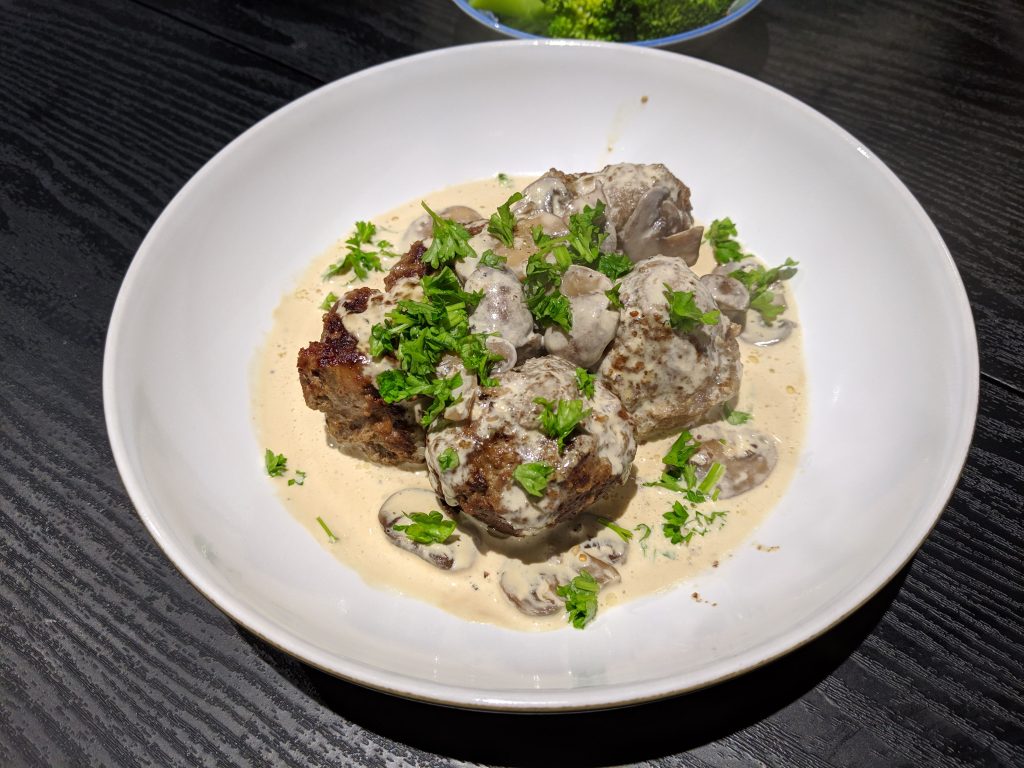
Description: Homemade meatball with creamy mushroom sauce. No additional sugar but a sweet and savoury dish. You may keep leftovers and cook some other dishes such as pasta later on.
Serves: 3 (15 meatballs)
Cooking time: 45 minutes
Ingredient
- Meatballs
- Beef mince (5%) – 500g
- Onion – chopped in small pieces, 2 pieces or 150g for meatballs
- large Egg – 1
- Garlic – chopped in small pieces, 4 cloves
- Single cream – 100 mL
- Bread crumble – 50g
- Nutmeg – 1 teaspoon
- Parsley – chopped, 1 tablespoon
- Wheat flour – 2 tablespoons
- Unsalted butter – 5g
Sauce: - Unsalted butter – 10g
- Onions – chopped in small pieces, 1 piece or 70g for the sauce
- Brown mushrooms – sliced, 160g
- Beef stock cube – 1
- Single cream – 100mL
Method
Meatballs
1. In a non-stick frying pan, add unsalted butter and fry the onion until it gets brown over low heat.
2. Mix all the ingredients including the onions fried on procedure #1 for the meatballs.
3. Shape the meat into round balls and put flour on their surface on a flat plate.
4. Fry them in a large non-stick pan over medium heat, turning them occasionally and place a lid while cooking.
Sauce
1. Fry mushrooms in the same pan you used to cook onions in #1 (so that you don’t need to use extra oil).
2. When mushrooms are cooked, add the stock cube, black pepper and 450 mL of hot water. Mix well.
3. When the sauce is completely boiled, add the cream and simmer. Stop the heat before it completely boils. Thicken it with wheat flour if preferred.
To serve: sprinkle fresh parsley.
Nutritional Values Per Serving
| Kcal | Protein | Fat | Carbs | Fibre | Sugars | Salt | Saturated Fat | Zinc | Vitamin B6 | Phosphorus |
|---|---|---|---|---|---|---|---|---|---|---|
| 509.2 | 43.4g | 23.8g | 29.6g | 3.2g | 6.7g | 2.1g | 13.0g | 9.6mg | 0.9μg | 458.3mg |
| 25.5% | 86.8% | 34.0% | 11.4% | 10.8% | 7.4% | 35.0% | 64.8% | 136.5% | 72.9% | 83.3% |
Nutritional Tips
As you can see in the picture, this dish is savoury and should be a special meal. Due to the usage of cream sauce, it is high in fat and salt. So you may consider eating light for other meals, adding more carbs such as bread, rice, quinoa or potatoes while eating less protein and salt. Meat is generally rich in protein, vitamin Bs (especially B3 and B12), iron, zinc and phosphorus.
More than half of the iron in our body can be found in the red blood cells as haemoglobin and it carries oxygen around our body. There are two types of irons, one is haem iron and the other is non-haem. Haem is derived primarily from meat or meat products (haemoglobin and myoglobin) and it is absorbed better than non-haem iron from plant sources such as pulses, beans or fruits. In the UK, cereal products, bread, and wheat flours are fortified with iron by law (Geissler and Powers, 2012, 12th edition Human Nutrition). The average absorption of iron from meat may be approximately 20-25%. Inorganic iron can be much lower and it is absorbed only when it is as Fe2+ (reduced form). Reducing agents such as ascorbic acids (e.g. lemon), malic acids (e.g. apple), lactic acids (e.g. yoghurt) or tartaric acids (e.g. grapes) and alcohol will help to increase absorption. On the other hand, dietary fibre, egg yolk protein, legume protein, phytate and tannins may have adverse effects (Department of Health, 2012, Dietary Reference Values for Food Energy and Nutrients for the United Kingdom). So it is important what you eat with non-haem iron because its absorption is less efficient and can be affected by consuming certain dietary elements.
Anaemia is a common nutritional disorder. Inadequate iron intake from the diet is a leading cause and vegetarians are more likely to suffer from it due to their diet (their diet is based on plant-based). Anaemia also can be caused by Folate or vitamin B12 deficiency (especially, for those who follow a vegan diet). Symptoms are tiredness, shortness of breath or palpitations. There are several types of anaemia. For example, iron deficiency anaemia is caused by a drop in haemoglobin concentration (not full of haemoglobin) although red blood cells (RBC) are produced at a normal rate. Because iron is necessary to synthesise the oxygen carrier haemoglobin), the size and haemoglobin density of the red cell (erythrocyte) is reduced: pale (microcytic, hypochromic) red blood cells. These small corpuscles have a low mean volume (MCV) and lower mean concentration of haemoglobin (MCHC). On the other hand, in folate or vitamin B12 deficiency anaemia, we can see the process of erythropoiesis (production of red cells) is inadequate and circulation of red cells is in fewer numbers and unusually large (macrocytic). (Geissler and Powers, 2012, 12th edition Human Nutrition).
Excess iron is harmful to our body and it causes vomiting, diarrhoea and ultimately damage to the intestines and liver. Excess iron accumulates in the liver progressing from fibrosis, cirrhosis then liver cancer. However, if it’s detected in the early stage it can be treated. In addition, high doses are fatal for children, so if you are taking iron supplements, it is important to keep it out of reach. It is recommended to 8.7mg a day for men over 18 and 14.8mg a day for women aged 19 to 50, however women with high menstrual losses might need to take iron supplements (Department of Health, Dietary Reference Values for Food Energy and Nutrients for the United Kingdom, 2016). As always, you must seek professional advice when in doubt.
 Mignonne Nutri-Cuisine