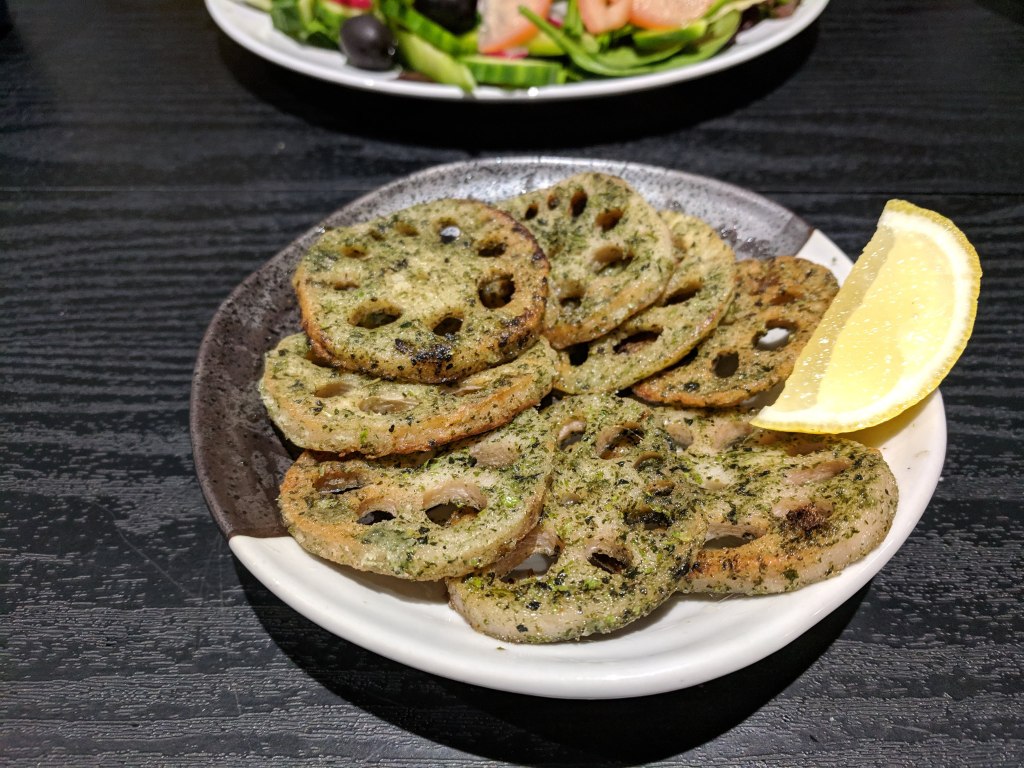
Description: A nice and crunchy side dish or even a starter. It is easy and fast to cook, but it is also fast to go inside our stomach. This can be also a good canapé.
Serves: 2
Cooking time: 25 minutes
Ingredients
- Lotus roots – slices 3 to 5mm width, 120g
- Potato flour (Alternatively, wheat flour) – 1 tablespoon
- Sunflower oil – 1 tablespoon
- Aosa powder (Aonori seaweed powder) – ½ tablespoon
- Salt – according to personal taste
Method
1. Remove the skin of the Lotus roots and soak in vinegar water for 5 to 10 minutes (1 teaspoon of vinegar for 200ml water). Alternatively, you may just use simple water.
2. In a small bowl, mix potato flour and seaweed powder.
3. Add lotus root in a bowl and pad to cover the surface.
4. Heat up a small non-stick frying pan over medium heat, add sunflower oil and cook both sides of lotus roots until they get slightly brown. You may close the lid so that steam would help to cook as well.
To serve: Sprinkle salt or squeeze lemon.
Nutritional Values Per Serving
| Kcal | Protein | Fat | Carbs | Fibre | Sugars | Salt | Saturated Fat |
|---|---|---|---|---|---|---|---|
| 124.1 | 2.1g | 7.1g | 14.6g | 3.6g | 0.2g | 0.2g | 0.5g |
| 6.2% | 4.3% | 10.1% | 5.6% | 11.6% | 0.2% | 3.1% | 2.6% |
Nutritional Tips
Lotus Roots are low in sugar, and fat and moderately low in calories for a vegetable (74 kcal per 100g). They are known as renkon:レンコン/蓮根 in Japanese and they may help reduce blood cholesterol, sugar, body weight and constipation due to their fibre content. Lotus roots are actually quite versatile and they can be cooked as tempura, kinpira, sautée, burger, hamburger steak, salad, pasta, and chips. You can find frozen lotus roots in some Asian shops. So you can always have a stock in a freezer when you need it. Vegetables are usually frozen and packed after the harvest and they are fresh (at their peak of ripeness). Therefore, they are more likely to retain nutritional values. Sometimes they may be richer in nutritional values than others which have traveled across countries and stored for a long time before sitting on your table.
Aonori seaweed powder gives a nice flavour to the dish. You can eat it without adding any salt. Lemon is nice to add some freshness. You might feel the dish is bland in the beginning and be tempted to add some salt, however, if you keep trying to go for lower-salt dishes, the human tongue adjusts its sense. You may try to reduce the salt intake by reducing additional salt or the consumption of ready-made meals. At some point, you will start feeling more ingredients’ tastes and start feeling that ready-made food has a really thick taste 🙂 This is my own experience, but there are some studies as well supporting this (Beauchamp et al, Annals of Internal Medicine, 1983 May;98(5 Pt 2):763-9., Blais et al, American Journal of Clinical Nutrition. 1986;44(2):232–243. , Mattes, American Journal of Clinical Nutrition. 1997;65(2 (Supplement)):692S–697S., Bertino et al, American Journal of Clinical Nutrition. 1982;36(6):1134–1144 ). I understand that everyone has a different tongue, but trying is free. So why don’t you try?
 Mignonne Nutri-Cuisine