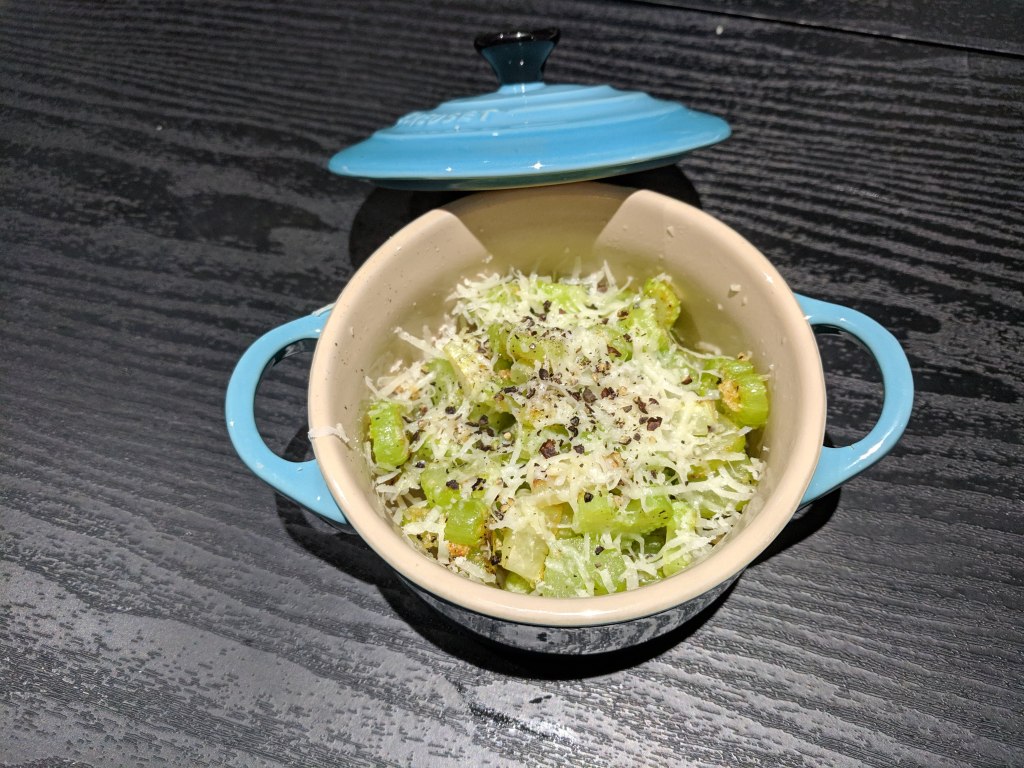
Description: Very easy and quick-to-cook yet healthy recipe. This helps to achieve one of 5 A Day. Serving celery with cheese and garlic, it actually gives a nice taste with a punch of black pepper flavour for both celery lovers and haters.
Serves: 2
Cooking time: 10 minutes
Ingredients
- Celery – cut into a bite-size, 3 stalks or 180g
- Parmesan cheese – 20g
- Garlic – cut into small pieces, 2 cloves
- Olive oil – 1 teaspoon
- Ground black pepper – according to personal taste
Method
1. In a non-stick pan, fry the garlic with olive oil over medium heat until it gets crispy.
2. Add the celery in the pan and fry for a few minutes.
3. Put them in a little bowl or plate then sprinkle some grated parmesan cheese and black pepper on top. Cover the bowl or the plate so that the cheese will naturally melt with the heat.
To serve: Squeeze a lemon or sprinkle ground black pepper if you prefer.
Nutritional Values Per Serving
| Kcal | Protein | Fat | Carbs | Fibre | Sugars | Salt | Saturated Fat |
|---|---|---|---|---|---|---|---|
| 76.3 | 4.4g | 5.0g | 4.0g | 1.5g | 1.2g | 0.5g | 1.6g |
| 3.8% | 8.8% | 7.1% | 1.5% | 5.0% | 1.4% | 7.9% | 7.9% |
Nutritional Tips
By frying celery, it helps reduce the strong smell and taste of celery for vegetable haters. As the Celery is a low-calorie vegetable, adding a bit of cheese on top to achieve one of 5 A Day is not bad. It contains 14 kcal per 100g which is even lower than courgette the same weight and 1 stalk is just about 9 kcal. So you would just take 76.3 kcal per serving which is still lower than a bar of chocolate (44g of a Snickers bar contains 215 kcal / fun-size contains 73 kcal). Imagine: just a bite of chocolate is equal to this meal.
The celery is not particularly high in vitamins or minerals and is low in protein, carbs and fat as it is mostly made of water (about 95 per cent). It is a good source of vitamin K, some folate, potassium, and fibre and contains small amounts of vitamin C, vitamin A and vitamin Bs. It is also known as a great source of important antioxidants (flavonoids such as luteolin, and kaempferol) which protect our cells, blood vessels and organ systems from oxidative damage. You can eat it raw, so it is one of the best snacks for munching to help weight control / avoid eating sweets or crisps. Especially in summer, it would prevent dehydration.
Celery can be kept in the fridge for a longer time compared to other vegetables such as bean sprouts, asparagus, okra or avocado. However, it is better to consume as soon as possible (5 to 7 days, I would not recommend keeping more than a week). While some nutrients are stable in storage, amounts of phenolic antioxidants greatly decline through a long storage period. Due to the changes in flavonoid content, I would recommend chopping it only before consumption and this will help preserve nutrients better. Do not pre-cut and store in the box, less nutrients will remain in the vegetable while you might think you are still eating healthy or making an effort to eat vegetables (which is a waste).
 Mignonne Nutri-Cuisine