Description: One of the nice Japanese flavour side dishes. This dish really goes well with steamed rice and miso soup which are traditional in a Japanese meal. Dashi and meat tastes are well infused in daikon radish.
Serves: 2
Cooking time: 20 minutes
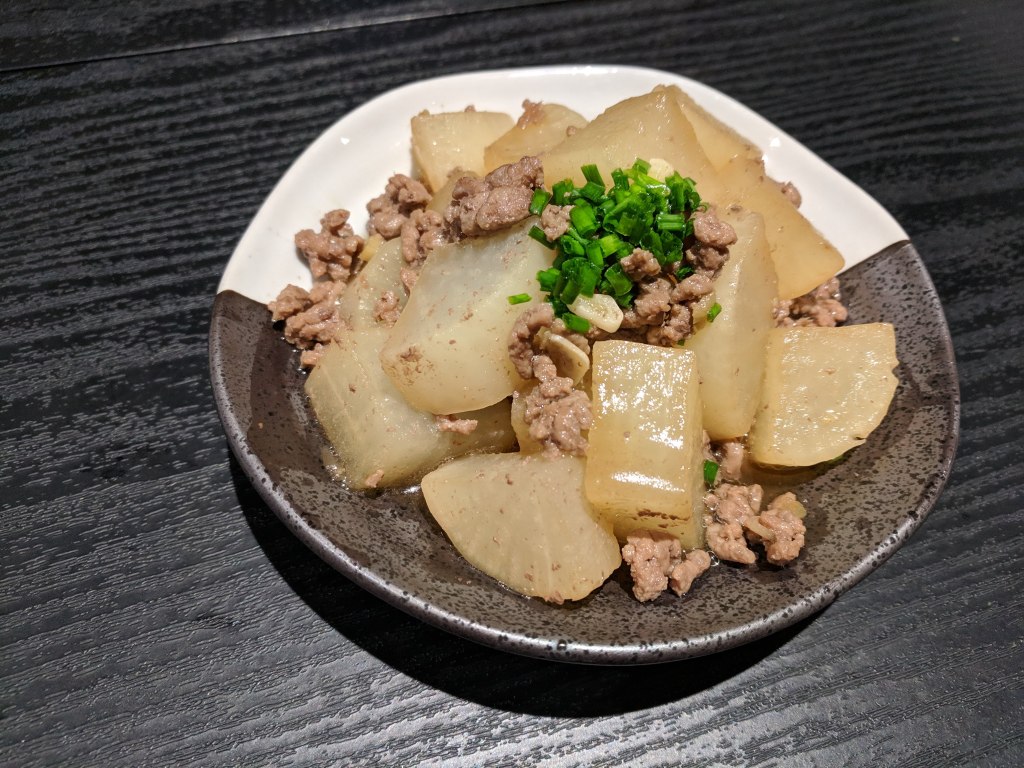
Ingredients
- Daikon radish – cut into a quarter slice, 200g
- Beef mince (10%) – 60g
- Ginger – chopped in small pieces, 5g
- Garlic – crushed or chopped, 2 cloves
- Dashi stock – 200 mL of bonito or kombu kelp dashi stock (You may cook it from scratch – boil the water, switch the heat off, then add 10g of bonito flake wait for 3 minutes, then sieve them with kitchen paper or fine cloth. Alternatively, use extract dashi powder 1g + 200 mL of hot water)
- Soy sauce – 1 teaspoon
- Mirin – ½ teaspoon
- Chive – chopped, 1 teaspoon
Method
1. In a small non-sticky pod, add minced meat, garlic, and daikon radish and fry until the meat is mostly cooked.
2. Add the dashi stock and boil. Cook until the radish is soft and most dashi is absorbed.
3. Top it up with chive.
Nutritional Values Per Serving
| Kcal | Protein | Carbs | Fat | Fibre | Sugars | Salt | Saturated Fat | Vitamin B12 | Vitamin C | Zinc |
|---|---|---|---|---|---|---|---|---|---|---|
| 83.0 | 7.5g | 3.2g | 6.3g | 1.8g | 2.9g | 0.5g | 1.2g | 0.7μg | 23.9mg | 1.7mg |
| 4.1% | 15.0% | 4.5% | 2.4% | 5.9% | 3.3% | 8.7% | 6.1% | 44.2% | 59.8% | 23.7% |
Nutritional Tips
Daikon actually means “big root” in Japanese. You might think that Daikon radish is too plain and often eaten in hot pots, but daikon radish can turn into so many different dishes. Because it is plain on its own, if you cook it with seasoning, it absorbs flavours really well and becomes a delicious vegetable ! It can be eaten uncooked or cooked, as part of a salad or as part of garnishes for sushi or tempura, miso soup, vegetable soup with broth…
This dish is one of your 5-A-Day and daikon radish is rich in Vitamin C and low calories (18 kcal / 100g according to USDA). Vitamin C can be found in various foods such as tomatoes, lotus roots, red/yellow/green peppers, strawberries, blackcurrants, broccoli, brussels sprouts, potatoes etc. although people would come up with the equation of “vitamin C = orange”.
Vitamin C leaches into water during boiling compared to steaming or microwaving. If you cook vegetables, I would suggest to minimise contact with water. If you boil, you may use the remaining water for soup to maximise the nutrient intake. Therefore eating raw ingredients (if edible) is probably the best way to take Vitamin C without loss due to cooking. You may try cooking using a different method as you also need to enjoy eating (especially in winter we would like to eat warm heated food instead of cold salad). Some food such as potatoes is better to be cooked because solanine causes diarrhoea, nausea, cramping and in the worst case organ failure. So forget about vitamin C intake from potatoes without cooking but look at the good side of potatoes: potatoes are a good source of energy (carbohydrate) and if you eat the skin, you can increase your fibre intake.
 Mignonne Nutri-Cuisine