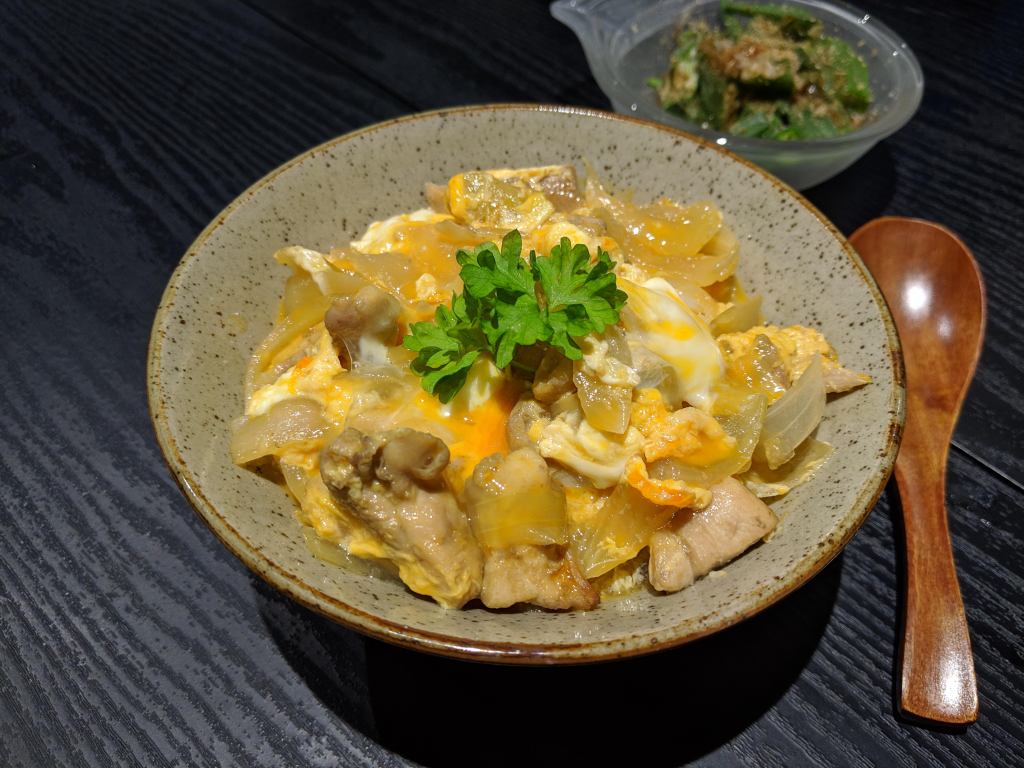
Description: Easy and fast to prepare. One of the popular Japanese dishes. Soft and creamy egg and chicken with slightly sweet tastes go really well with rice. I use “Clarence Court” eggs (UK) for this recipe as they are so creamy, vibrant and intense. It works really well for this dish as you can fully enjoy the egg taste and texture.
Serves: 2
Cooking time: 15 minutes
Ingredients
- Chicken – chopped into a bite size, 180g
- Onion – chopped in 1 cm width, 1 piece or 150g
- Large Egg – 2 pieces (“Clarence Court” was used)
- Dashi stock – 600 mL of bonito or kombu kelp dashi stock (You may cook it from scratch – boil the water, switch the heat off, then add 25g of bonito flake wait for 3 minutes, then sieve them with kitchen paper or fine cloth. Alternatively, use extract dashi powder 4g + 150 mL of hot water)
- Soy sauce – 1 tablespoon
- Mirin cooking wine- 1 tablespoon
- Sake cooking wine- 1 tablespoon (optional)
- White Rice cooked – 250g
- To serve: Sprinkle spring onions or parsley on top according to personal preference
Method
1. Add chicken and onions in a pot. Add water, dashi, soy sauce, Mirin, and Sake then boil in strong heat. Once it is boiled, simmer for about 10 minutes (the soup should have now thickened).
2. Break the eggs and beat them a bit (not too much so they solidify nicely but in a jelly-like texture: ぷるんぷるん – see picture). Pour them into the pot, close the lid, and stop the heat when the eggs are runny.
3. Put the rice first then put the content of the pot (chicken, egg, onions) on top. Sprinkle parsley or chives as you prefer.
Nutritional Values Per Serving
| Kcal | Protein | Fat | Carbs | Fibre | Sugars | Salt | Saturated Fat | Zinc | Phosphorus | Vitamin B12 |
|---|---|---|---|---|---|---|---|---|---|---|
| 519.1 | 28.2g | 20.2g | 54.1g | 2.5g | 5.6g | 1.9g | 5.7g | 2.9mg | 316.6mg | 1.0μg |
| 26.0% | 56.4% | 28.8% | 20.8% | 8.2% | 6.3% | 30.9% | 28.4% | 40.8% | 57.6% | 66.9% |
Nutritional Tips
Eggs are known as one of the superfoods as they are extremely nutritious, containing a very large amount of nutrients compared to calories (a large egg contains 72kcal with 6.3g of protein 4.8g of fat, and trace amounts of carbohydrates according to USDA). It is rich in phosphorus, vitamin A, D, B2, B12, and also contains small amounts of almost all vitamins and minerals our body needs, which are calcium, iron, potassium, zinc, vitamin E, folate, and many more. Eggs are also a good source of vitamin B1, B3. The yolk contains most nutrients while egg white contains only protein. Eggs are also filling and they are used in some diet programs to help lose weight as they make you feel full and eat overall less calories. They used to be considered unhealthy because they contain cholesterol. However, it is said that saturated fat affects the cholesterol in the blood (Keys et al, Cambridge Mass: Harvard University Press, 1980). In general, cholesterol-rich foods are also high in saturated fatty acids. Therefore, it may increase the risk of cardiovascular diseases. However, eggs are exceptional and as I stated earlier, they are nutrient-dense food items and can be used in so many different ways (fry-up, omelette, poached, or as part of a dish such as pancakes, minced meat steaks) and in different forms from runny to hard. I personally think that eggs should always be in the fridge to boost health.
 Mignonne Nutri-Cuisine